
ADVANCED PROTECTION FOR SENSITIVE SKIN
DPG-FREE GLOVES
Skin diseases are one of the most common occupational illnesses. One of the primary skin diseases is contact dermatitis. This can be divided into irritant toxic and allergic contact dermatitis (Type IV allergy). Contact dermatitis is prevalent in the healthcare sector. Nurses and nursing assistants count for the largest share, followed by medical assistants and physicians.
Understanding Allergic
contact dermatitis
Allergy despite elimination of latex
Despite the transition to powder-free latex gloves and synthetic gloves since the turn of the millennium, resulting in a significant decline in latex allergy (Type I allergy), Type IV allergies such as allergic contact dermatitis have noticeably increased.⁷
In hospitals, the switch from latex to synthetic gloves has led to a rising number of contact allergies among employees who previously did not show hand dermatitis.⁷ ⁸ ⁹
Successful risk reduction with DPG- and accelerator-free gloves
Allergic contact dermatitis caused by gloves is primarily attributed to sensitization to accelerators and other process chemicals. ¹⁰ ⁶ The most relevant allergens identified were thiuram and 1,3-diphenylguanidine (DPG), with the significance of DPG increasing significantly in recent years.⁷ ¹¹
Research suggests that DPG is particularly allergenic.⁷ ¹² ¹³
DPG-free gloves recommended
It is advised to choose accelerators with low allergenic potential (e.g., long-chain or highly branched accelerators) or accelerators that are decomposed or broken-down during manufacture.⁷
Studies indicate that the presence of alcoholic solvents (e.g., from the use of hand sanitizers prior to donning sterile gloves) may increase the release of DPG.¹⁴ Therefore, the use of DPG-free gloves is recommended.
The SOLUTION
A DPG- AND LATEX-FREE PORTFOLIO
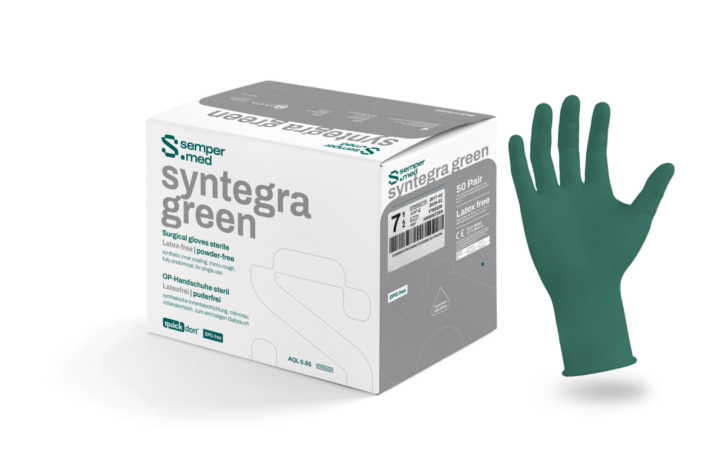
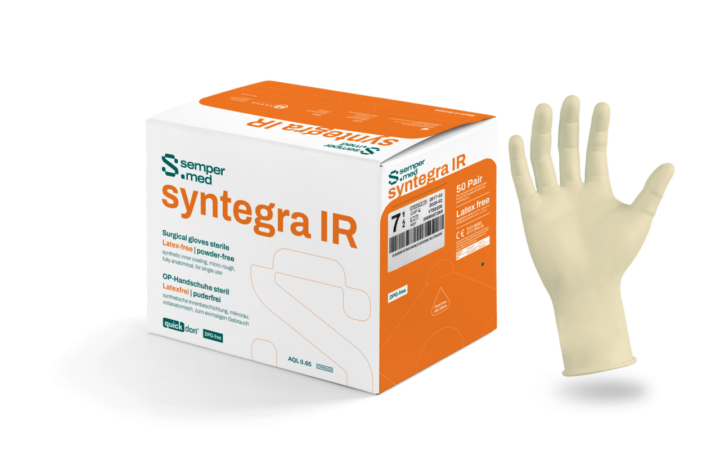
For our conventionally crosslinked products (syntegra IR and syntegra green), HARPS Global uses an accelerator system consisting of a long-chain accelerator (from the dithiocarbamate group) in combination with a thermo-reactive molecule that decomposes residue-free during manufacturing.
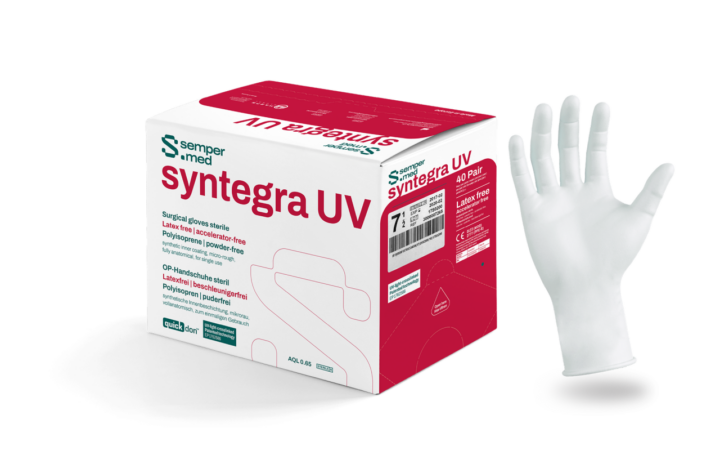
For highly sensitized users, HARPS Global offers a product (syntegra UV) that completely avoids the use of vulcanization accelerators. Instead, crosslinking is achieved through UV light. This product is therefore ideal for people with Type IV allergies.
Protects Skin from Common Allergens
DPG (diphenylguanidine) is a chemical accelerator used in manufacturing—and can be linked to allergic contact dermatitis in healthcare workers.
Why it matters: DPG-free gloves help reduce exposure to a known irritant, protecting clinicians, nurses and end-users from disruptive skin reactions.
Reduces Risk of Chronic Hand Irritation
Reduce the risk of chronic hand irritation and dermatitis
At times, many contact dermatitis issues are tied to chemical accelerators, not latex itself.
Why it matters: Eliminating DPG helps prevent redness, itching and long-term skin damage—especially critical with frequent glove changes.
Supports All-Day Comfort and Protection
Should accelerator residues leach from gloves and contact the skin—DPG-free gloves can minimize the potential of this and occurances
Why it matters: Even after long shifts, DPG-free gloves support in minimizing chemical exposure, improving comfort across repeated donning, double-gloving, and extended procedures.
Enables Safer Use for Sensitive Staff
Enables safer use for sensitive staff
Healthcare workers with existing Type IV (chemical) allergies should avoid triggers entirely—removal is the primary prevention strategy.
Why it matters: DPG-free gloves provide a reliable solution for sensitive users, helping maintain workforce health, compliance, and productivity.
Elevates Glove Safety Without Compromise
Elevate overall glove safety—without compromising performance
Advanced manufacturing allows gloves to deliver latex-like performance with minimal chemical residue and improved skin compatibility.
Why it matters: Clinicians, nurses and end-users do not have to trade protection or tactile sensitivity for skin safety.
OUR DPG- AND LATEX-FREE PORTFOLIO
For our conventionally crosslinked products (syntegra IR and syntegra green), we use an accelerator system consisting of a long-chain accelerator (from the dithiocarbamate group) in combination with a thermo-reactive molecule that decomposes residue-free during manufacturing.
For highly sensitized users, we offer a product (syntegra UV) that completely avoids the use of vulcanization accelerators. Instead, crosslinking is achieved through UV light. This product is therefore ideal for people with Type IV allergies.
-

sempermed® syntegra UV
$1.00Syntegra UV can provide long‑term relief for users suffering from prolonged exposure to chemical residues used in conventional surgical gloves.… -
sempermed® syntegra green
$1.00Thanks to its smooth surface texture and optimized fit, sempermed® syntegra green provides increased safety, making it the ideal surgical… -
sempermed® syntegra IR
$1.00A synthetic polyisoprene surgical glove providing a latex‑free solution with latex‑like comfort and grip, designed for skin‑friendliness, user safety, and… -
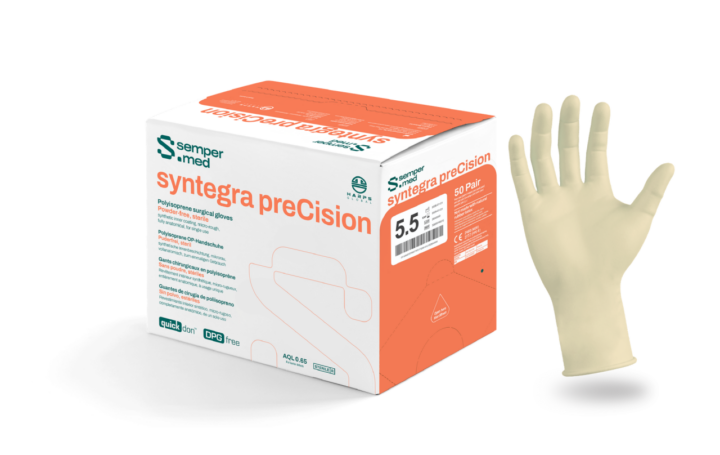
sempermed® syntegra preCision
$1.00The optimized, natural latex-free sempermed® syntegra preCision made of synthetic polyisoprene enables precise tactile sensitivity in highly delicate environments. Its…
Want to know more?
Read our brochure and learn more about DPG.
We are happy to advise you on our solutions
References
To access references click
¹ Bauer, A., Pesonen, M., Brans, R., Caroppo, F., Dickel, H., Dugonik, A., Filon, F. L., Geier, J., Arnau, A. G., Napolitano, M., Patruno, C., Rustemeyer, T., Simon, D., Schuttelaar, M. L. A., Śpiewak, R., Stingeni, L., Vok, M., Weißhaar, E., Wilkinson, S. M., . . . Uter, W. (2023). Occupational contact allergy: The European perspective–Analysis of patch test data from ESSCA between 2011 and 2020. Contact Dermatitis, 88(4), 263–274. https://doi.org/10.1111/ cod.14280https://doi.org/10.1111/cod.14280
² Bains, S. N., Nash, P. & Fonacier, L. (2018). Irritant contact dermatitis. Clinical Reviews in Allergy & Immunology, 56(1), 99–109. doi.org/10.1007/s12016-018-8713-0
³ Pesonen, M., Jolanki, R., Filon, F. L., Wilkinson, S. M., Kręcisz, B., Kieć-Swierczyńska, M., Bauer, A., Mahler, V., John, S. M., Schnuch, A. & Uter, W. (2015). Patch test results of the European baseline series among patients with occupational contact dermatitis across Europe – analyses of the European Surveillance System on Contact Allergy network, 2002–2010. Contact Dermatitis, 72(3), 154–163. doi.org/10.1111/cod.12333
⁴ Alinaghi, F., Bennike, N. H., Egeberg, A., Thyssen, J. P. & Johansen, J. D. (2018). Prevalence of contact allergy in the general population: A systematic review and meta‐analysis. Contact Dermatitis, 80(2), 77–85. doi/10.1111/cod.13119
⁵ Krob, H., Fleischer, A. B., D’Agostino, R. B., Haverstock, C. L. & Feldman, S. R. (2004). Prevalence and relevance of contact dermatitis allergens: A meta-analysis of 15 years of published T.R.U.E. test data. Journal Of The American Academy Of Dermatology, 51(3), 349–353. doi.org/10.1016/j.jaad.2003.11.069
⁶ Huang, C. H., Greig, D. & Cheng, H. (2021). Allergic contact dermatitis in healthcare workers. Occupational Medicine, 71(6–7), 294–297. https://doi.org/10.1093/occmed/kqab118 Allergic contact dermatitis in healthcare workers. Occupational Medicine, 71(6–7), 294–297. doi.org/10.1093/occmed/kqab118
⁷ Dejonckheere, G., Herman, A. & Baeck, M. (2019). Allergic contact dermatitis caused by synthetic rubber gloves in healthcare workers: Sensitization to 1,3‐diphenylguanidine is common. Contact Dermatitis, 81(3), 167–173. doi.org/10.1111/cod.13269
⁸ Baeck, M., Cawet, B., Tennstedt, D. & Goossens, A. (2012). Allergic contact dermatitis caused by latex (natural rubber)‐free gloves in healthcare workers. Contact Dermatitis, 68(1), 54–55. doi.org/10.1111/j.1600-0536.2012.02054.x
⁹ Cao, L., Taylor, J. S., Sood, A., Murray, D. A. & Siegel, P. D. (2010). Allergic Contact Dermatitis to Synthetic Rubber Gloves. Archives Of Dermatology, 146(9). doi.org/10.1001/archdermatol.2010.219
¹⁰ Geier, J., Lessmann, H., Mahler, V., Pohrt, U., Uter, W. & Schnuch, A. (2012). Occupational contact allergy caused by rubber gloves – nothing has changed. Contact Dermatitis, 67(3), 149–156. doi.org/10.1111/j.1600-0536.2012.02139.x
¹¹ Geier, J., Lessmann, H., Uter, W. & Schnuch, A. (2003). Occupational rubber glove allergy: results of the Information Network of Departments of Dermatology (IVDK), 1995-2001. Contact Dermatitis, 48(1), 39–44. doi.org/10.1034/j.1600-0536.2003.480107.x
¹² Pontén, A., Hamnerius, N., Bruze, M., Hansson, C., Persson, C., Svedman, C., Andersson, K. T. & Bergendorff, O. (2012). Occupational allergic contact dermatitis caused by sterile non‐latex protective gloves: clinical investigation and chemical analyses. Contact Dermatitis, 68(2), 103–110. doi.org/10.1111/cod.12010
¹³ Crépy, M. (2016). Rubber: new allergens and preventive measures. European Journal Of Dermatology, 26(6), 523–530. doi.org/10.1684/ejd.2016.2839
¹⁴ Services, D. O. H. A. H., Prevention, C. F. D. C. A. & Health, N. I. S. A. (2013). Effects of Skin Contact with Chemicals: What a Worker Should Know. CreateSpace.