
Food Regulations and Food Contact
What to look out for in gloves that come into contact with food
In some areas of the food industry, it is indispensable to wear gloves. Because a high level of protection and high standards of quality are necessary, you should take a couple of things into consideration before handling food with gloves.
The general rule for all food contact materials is that nothing may migrate to food that could either endanger human health, or deteriorate the composition or organoleptic characteristics of food. This is required by European regulation (EC) 1935/2004, which is applicable for all food contact materials in general.
Union-wide requirements exist only for PVC gloves, which are defined in Regulation (EU) 20/2011. Products from Natural rubber latex or Nitrile latex are specifically excluded from this regulation. Therefor, the European Member States have been authorised to adopt their own national regulations.
For non-PVC gloves, national specific measures are adopted. Among the most renowned national rules are the German “BfR Recommendation XXI” and the French “Arrete du 5 aout 2020”.
To ensure that high standards are met, please pay attention to this list when choosing and wearing a glove to handle food with:
“Food Contact” pictogram (see below)
AQL Level
Wall thickness
Blue glove color (recommended especially in sectors subject to the HACCP standards)
Correct glove size
Period of use (max. 1-2 hours)
Regular changing of gloves
Intended use
EU declaration of conformity and Declaration of Compliance for food contact, which must be issued according to the requirements of Regulation (EU) 1935/2004 (for NR or NBR gloves) or Regulation (EU) 10/2011 (for PVC gloves only)
Possible allergens or harmful substances in the glove material (latex proteins, accelerators, DOP/DEHP softeners, powder)
Food Pictogram
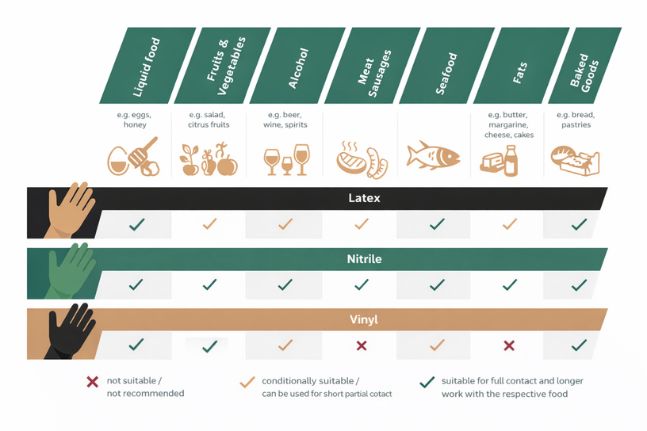
Recommendations on food handling suitability
This quick overview helps you decide which glove material is best suited to handle certain foods and drinks.
What requirements apply to gloves intended for food contact?
Gloves intended for food handling must comply with applicable food contact regulations in the respective market where they are placed on the market or used. Product labelling and accompanying documentation can help identify whether a glove has been evaluated for food contact suitability.
In the European Union, food contact materials are regulated under applicable EU food contact legislation. Gloves intended for food contact are commonly identified by the “glass and fork” symbol, indicating that the product is intended to come into contact with food under the specified conditions of use. Compliance assessment typically considers potential migration of substances from the glove material into food.
In the United States, food contact requirements are governed by the U.S. Food and Drug Administration (FDA). Depending on the glove material and intended application, compliance may involve conformity with relevant sections of the Code of Federal Regulations (CFR), including requirements related to indirect food additives and food contact substances.
In many countries across the Asia-Pacific (APAC) region and other international markets, local requirements for food contact gloves are still evolving. In practice, many regulatory authorities currently focus primarily on overall (global) migration requirements or reference internationally recognised frameworks, particularly European food contact principles and test methodologies.
Regardless of the region, glove selection for food handling should always consider the intended food type, duration of contact, temperature conditions, and material compatibility. Particular attention should be paid when handling fatty or oily foods, as certain glove materials (PVC) or additives may exhibit increased migration under such conditions.